Views: 23 Author: Site Editor Publish Time: 2026-05-13 Origin: Site
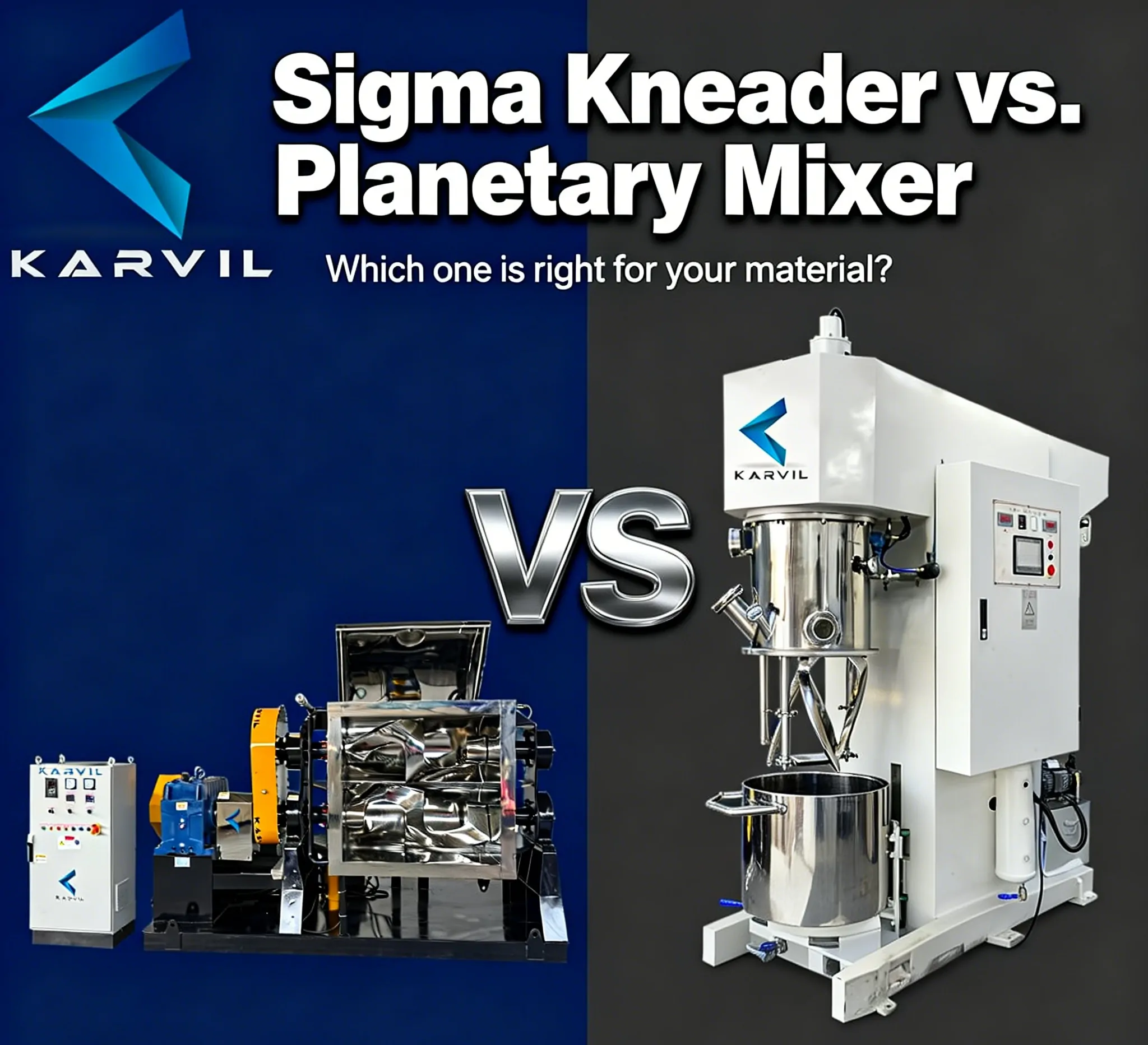
Every week, we receive inquiries from customers who are confused about one thing: "My material is very thick and sticky. Should I buy a Sigma Kneader or a Planetary Mixer?"
Since we are a direct manufacturer in China producing both machines, we don't need to push you toward one or the other. We just want to help you find the right equipment for your specific formula.
If you choose the wrong mixer, you might face broken mixing blades, burned-out motors, or material full of bubbles. In this article, we’ll explain the real differences between a Sigma Kneader and a Double Planetary Mixer in plain English, so you can make the right choice for your factory.
If your material looks like thick bread dough, hard chewing gum, or solid rubber, the Sigma Kneader is what you need.
How it works:
Inside a U-shaped mixing tank, there are two large Z-shaped blades. They rotate toward each other at different speeds. Instead of just "stirring" the material, these blades tear, stretch, and fold it. It relies on heavy, brutal force.
Why buyers choose it:
Massive Power: It handles ultra-high viscosity materials that would easily break a standard mixer.
Discharge options: Because the material is so thick, you can’t just pour it out. We usually design these machines to tilt the tank (hydraulic tilt) or use an extrusion screw at the bottom to push the material out.
What we usually use it for: Silicone rubber, hot melt adhesives, BMC/SMC, brake linings, and bubble gum.
If your material is more like a thick, sticky paste or slurry (it still flows a little bit), and you need it to be 100% perfectly mixed with no bubbles, you should look at the Double Planetary Mixer.
How it works:
Think about how planets move. The mixing blades rotate on their own axes, but they also travel around the mixing tank. This means the blades will pass through every single part of the tank.
Why buyers choose it:
Zero Dead Corners: There is nowhere for the powder or liquid to hide. You get a perfectly uniform mix.
Great Vacuum Performance: Because the tank is a closed cylinder, it’s very easy to pull a high vacuum. This pulls all the air bubbles out of your paste.
Easy to Clean and Batch: The mixing head lifts up, and you can roll the mixing tank away. You can buy one machine and three tanks to keep your production running non-stop.
What we usually use it for: Lithium battery slurry, polyurethane sealants, electronic conductive pastes, and dental materials.
To make things simple, here is a quick cheat sheet from our engineering team:
Viscosity: Kneader > Planetary Mixer (Kneaders handle the hardest, thickest stuff).
Mixing Quality (Fineness): Planetary Mixer > Kneader (Planetary gives a smoother, bubble-free paste).
Cleaning: Planetary Mixers are generally easier to clean because you can move the tank away. Kneaders usually need to be cleaned manually by workers inside the tank.
Heating/Cooling: Both machines can be built with heating/cooling jackets, but the Kneader transfers heat a bit differently due to the blade shape.
When you search for these machines online, you will find hundreds of suppliers. But many of them are trading companies.
We are a real manufacturing factory. This means a few things for your business:
We customize: Do you need ABB motors? SKF bearings? Siemens PLC? Or maybe a special 316L stainless steel for food-grade production? Tell us, and our engineers will draw the 3D model for you.
Real Factory Testing (FAT): Before we ship the machine, we test it in our workshop. We even encourage customers to send us their raw materials so we can shoot a test-run video for you.
Better Prices: You are buying directly from the welding and assembly line, skipping the middleman's markup.
Still not sure which machine is right for your production line? Don't guess.
Send us an email with your material name, viscosity (if you know it), and how many liters you want to produce per batch. Our engineers will check it and give you a proper recommendation and a direct factory price.
[Click here to Contact Us: www.karvil.com ]
[View our Sigma Kneader models: https://www.karvil.com/Sigma-Mixers-pl3620183.html]
[View our Planetary Mixer models: https://www.karvil.com/Planetary-Mixers-pl3720183.html]


