Views: 44 Author: Site Editor Publish Time: 2026-02-05 Origin: Site
If you find yourself working with powders that break easily, you know that every single turn of a mixing blade can feel like a huge gamble. You have probably spent a lot of time and money making sure your product has the perfect particle size, only to worry that the mixing process might crush those granules into a pile of useless dust. Deciding between a ribbon mixer and a paddle mixer is not just a choice based on price or how fast the machine goes; it is really about making sure your material stays in one piece and keeps its quality.
I have spent many years looking at the tricky details of industrial mixing, and I have seen firsthand how picking the right machine can either make a production line run perfectly or turn it into a total disaster. This is where Karvil comes into the picture as more than just a company that builds machines; we act as a partner who knows the science of materials. Based on decades of building and improving equipment, we focus on creating blending setups that care about the physical shape of your product. Whether you are dealing with the very strict cleanliness rules of the food business or the dangerous needs of making rocket fuel for space travel, we build the strong mechanical parts that help your ideas come to life. My approach is very much focused on the people involved—we do not just sell big pieces of steel; we give you the comfort of knowing that your easily broken materials are being handled by experts who truly care. From the very first time we test your material to the day-to-day help we give to factories all over the world, we make sure your machinery grows right along with your business. We take pride in being a steady hand in an industry that is always changing, and we want to help you succeed.

To pick the best tool for your job, you first need to look closely at how these two different systems actually move your product around. Even though both machines are horizontal mixers, the way the metal parts are shaped inside creates two very different worlds for your powder particles.
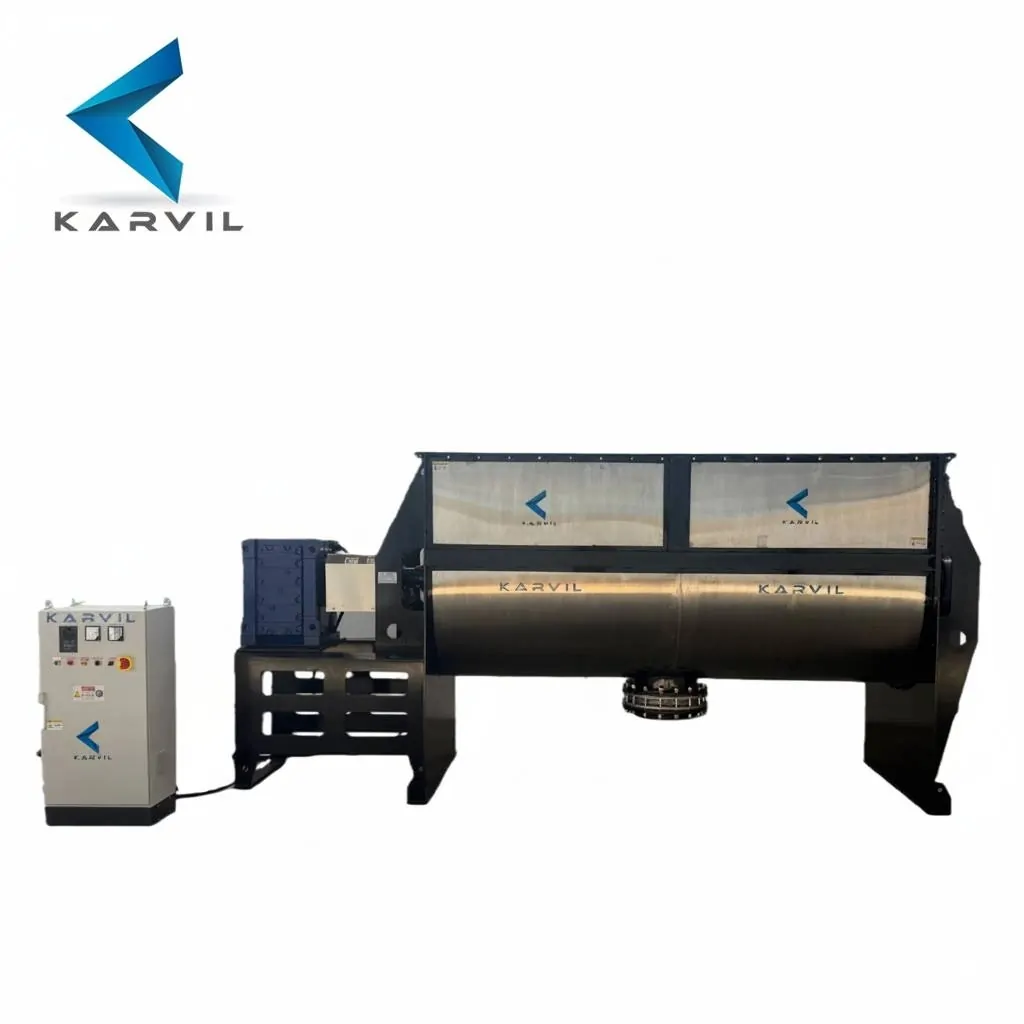
The ribbon blender uses a special double-screw shape called a helix. There is an outer ribbon that pulls the material toward the middle and an inner ribbon that pushes it back toward the ends. This creates a back-and-forth flow that is incredibly fast at getting everything mixed together perfectly. However, because the ribbon covers a large area and usually stays very close to the walls of the container, it creates spots where the powder gets pressed hard. If your powder is what we call "friable"—which just means it breaks or crumbles easily when pushed—this pressing action can lead to your particles getting smaller than you wanted them to be. It is a bit like rubbing the powder against the wall, which is fine for tough materials but bad for delicate ones.
On the other hand, a paddle mixer uses big, flat blades that are set at specific angles. Instead of pushing the material in a steady stream along the bottom, these paddles actually lift the material up into the air. This creates a "tumbling" effect where the particles mix because of gravity and soft bumps rather than being forced against each other by friction. If you are worried about keeping the shape of a tiny crystal or a special coated bead, the lifting motion of the paddle is usually a lot kinder to your product. It treats the powder more like a gentle toss than a heavy push.
A lot of people will tell you that you have to give up speed if you want to keep your product safe, but that is a bit too simple. The real goal is to find a machine that has enough power to mix everything well without hitting the "breaking point" of your particles.
In many jobs involving chemicals or building materials, having a lot of "shear" or pressure is actually a good thing because it breaks up big chunks. But in the food and medicine world, this pressure is often your biggest enemy. When a ribbon turns at high speeds, the rubbing between the metal and the powder creates heat. This heat, combined with the way particles get "pinched" against the side of the tank, can really damage sensitive stuff.
If your specific job really needs the Horizontal Ribbon Mixer Machine because it mixes things so fast, you can still find ways to stop the material from breaking. One great way is to use a Variable Frequency Drive. This is a fancy way of saying you can control the speed. By slowing down the spinning during the last few minutes of the mix, you keep the blend quality high but stop the most fragile parts of your recipe from getting crushed.

For materials that are very easy to snap or break, the paddle mixer is usually the better choice. Because the paddles do not touch as much of the wall as a long, continuous ribbon does, there are fewer places where the powder can get caught and squashed. This makes it a great pick for mixing things that have different weights or shapes. The lifting action makes sure that the heavy pieces do not just sink to the bottom and get flattened by the weight of everything else. It keeps everything moving in a light, airy way.
When you sell products all over the world, especially things people eat or use as medicine, your machine has to do a lot more than just spin. It has to follow very strict international laws to make sure everyone stays safe.
Safety is a huge part of how we think about design. We know that factories can be dangerous places, so our machines are built to match your highest safety needs. For example, we put special sensors on the lids that act as an "emergency stop." If someone tries to open the cover while the machine is running, it stops instantly. Also, we cover up all the moving parts like chains, belts, and motors so that no one can accidentally touch them while they are moving.
Your factory might have very specific rules about the environment. We make sure our equipment comes with CE certification as a basic standard. For places where there is a risk of explosions from dust in the air, we offer special ATEX explosion-proof setups.
In the food world, being clean is the most important thing. The materials we use to build our mixers have passed the EU food contact material test. They follow the (EC) No.1935/2004 regulations perfectly. This means you never have to worry about bad chemicals moving from the metal of the machine into the food you are making. We use high-quality stainless steel and polish it until it is smooth. This stops any tiny bits of food from getting stuck in corners where they could grow bacteria, which keeps every batch of your product safe and clean. Product materials have passed the EU food contact material test and comply with (EC) No.1935/2004 regulations.
Our history is not just about one type of business. We have sent our machines to more than fifty different countries, including almost every place in Europe and North America. Because we have worked in so many places, we have a huge amount of knowledge about how different materials behave. We use this knowledge to build a machine that fits your specific needs.
In the world of space travel and defense, we provide special mixing tools for things like rocket fuel and explosives. These are jobs where being exact and safe is a matter of life and death. Our kneading machines and planetary mixers are often picked for these heavy, high-stakes tasks.
In the food sector, our horizontal mixers are used for everything from mixing flour to making ice cream powders and protein bars. If you are making chewing gum or strong glues, our kneading technology provides the strength needed to move "tough" materials while keeping the temperature just right.
From the dry mortar used in building houses to the high-tech stuff used inside electric car batteries and dental tools, we change our designs to fit the weight and flow of your material. Whether it is a planetary mixer for battery liquid or a ribbon blender for cement, our years of experience mean the machine is set up exactly for your secret recipe. We have seen it all, and we know how to handle the unique challenges of each industry.
Buying a mixer is the start of a long friendship that should last for many years. We believe that the real value of a machine is how long it stays working, not just the price you pay at the start.
Every machine we sell comes with a solid one-year warranty. But our help does not stop after the first year is over. Our team offers technical advice for the entire life of the machine. If you start using a new material or change your production goals five or ten years from now, our engineers are here to give you advice through a call or email to help you fix your process.
To make sure your workers can start using the machine right away without any confusion, we include a full English manual and clear wiring diagrams with every order. This makes it easy for your local repair team to do regular check-ups. If a big problem happens that needs an expert, our professional engineers provide help from a distance. We use video calls and photos to solve problems fast, no matter where your factory is located in the world. We want to make sure your production line never stays stopped for long.
In the end, choosing between a ribbon mixer and a paddle mixer comes down to how "tough" your powder is. If you need to mix things very fast and your particles are strong enough to handle some rubbing, the ribbon blender is an amazing, high-speed choice. If your product is a delicate mix of granules that must stay in their original shape, the lifting motion of the paddle mixer is the best way to keep them safe.
No matter which one you pick, making sure the machine is safe, follows international laws, and comes with expert help is what will make your investment worth it for a long time.
A: Yes, definitely. Our ribbon blenders are built to follow (EC) No.1935/2004. We use stainless steel that is safe for food and special seals that keep the mixing area clean and easy to wash. This helps you meet the toughest health rules in the industry.
A: This is a tricky problem that we see a lot. Usually, we suggest a custom ribbon blender where you can change the speed, or a paddle mixer that has small, high-speed "choppers" added to it. The choppers break up the lumps while the paddles gently lift the rest of the fragile powder.
A: We give a lot of help from a distance. Since we provide English manuals and clear electrical maps with every machine, most small issues are easy to fix. If you need more help, our engineers can talk to your team through a video call or look at photos to find the problem quickly. Plus, our lifetime advice policy means we are always just one email away.


