Views: 104 Author: Site Editor Publish Time: 2024-10-25 Origin: Site
In the world of industrial mixing, the choice of the right equipment plays a crucial role in achieving optimal results. Two widely used mixing technologies are the Sigma Mixer and the Planetary Mixer. Both these mixers have their own unique features and advantages, making them suitable for various applications. In this article, we will delve into the differences between these two mixers, allowing you to make an informed decision when selecting the most suitable option for your specific needs.

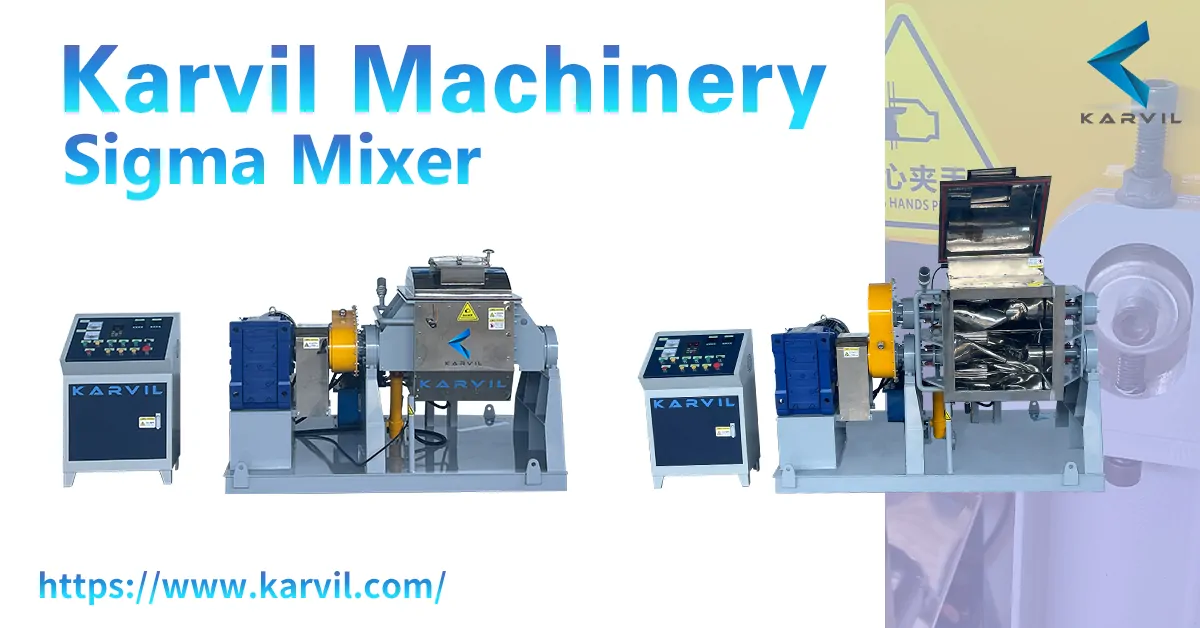
The Sigma mixer is usually composed of several major components such as the base part, the transmission system, the kneading system, the hydraulic system, the vacuum system, the screw system, the heating system/cooling system and the electrical control system.
Kneading machine is a special mixing equipment, which is most commonly made of two Σ blades, and takes the side-by-side tangent differential type arrangement. In that way, the speed of one mixing paddle is fast, while the speed of another mixing paddle is slow, in order to generate shear force. Different paddle speeds make the mixing material can be cut quickly, so that the material can be mixed evenly. The cylinder is operated by a hydraulic station to complete the functions of turning over the cylinder and opening the cover if needed. It can be designed into heating and non-heating forms according to the needs. The temperature exchange methods are usually: electric heating, steam heating, circulating hot oil heating, circulating water cooling, etc. It can also be designed with vacuum function according to the demand.
The discharge methods of the kneading machine include hydraulic cylinder tilting discharge, bottom ball valve discharge, screw extrusion, etc.

The planetary mixer is usually composed of several major components, such as the base part, the transmission system, the low-speed mixing system, the high-speed dispersion system, the hydraulic system, the vacuum system, the heating system/cooling system and the electrical control system.
The planetary mixer is usually equipped with a low speed stirring component and a high speed dispersing component. The low-speed mixing part is driven by planetary gear, and the mixing paddle also rotates when it is rotating. There are two groups of twist frame mixing slurry and one group of movable scraper on the low-speed axis for mixing, cutting, scraping and dissolving. The low-speed twist frame mixing slurry makes the material flip, cut and mix up and down in the closed container. The high-speed dispersing parts orbit together with the planetary frame, and at the same time rotate at a high speed, the toot-shaped dispersing disc produces strong impact and shear with the mixed materials. With the rotation of the twist frame mixing slurry, the movable scraper on the planetary frame rotates to completely scrape the materials on the kettle body, so that the aggregates completely and completely meet the requirements of mixing, dispersing and dissolving. Dispersion parts are divided into single dispersion shaft and double dispersion shaft, customers can choose according to requirements; The speed of the low speed mixing paddle and the high speed dispersing head in the kettle are adjusted by inverter. The different speeds and different mixing methods can be selected according to different viscosity as well as different processes.
The discharge methods of the planetary mixer include hydraulic press discharge, gear pump discharge, etc
The Sigma mixer has wider application industry. It has better working effect for kneading, mixing, crushing, curing and polymerization of high viscosity and high elastoplastic materials
The planetary mixer can rotate as it orbits, so that the material flows up and down and around, so that the mixing effect can be achieved in a very short time. The planetary mixer has a better effect on mixing, dissolving, dispersing and homogenizing a variety of liquids and powders.
When selecting the most suitable mixer for your specific needs, consider factors such as the desired mixing action, batch size, and maintenance requirements. By understanding the differences between sigma mixer with planetary mixer, you can make an informed decision that ensures optimal mixing results and productivity in your industrial processes.
If you're still unsure about how to choose, Karvil Machinery is here to help you choose the right mixing equipment for your unique needs. Contact us today!


