Views: 29 Author: Site Editor Publish Time: 2021-04-27 Origin: Site
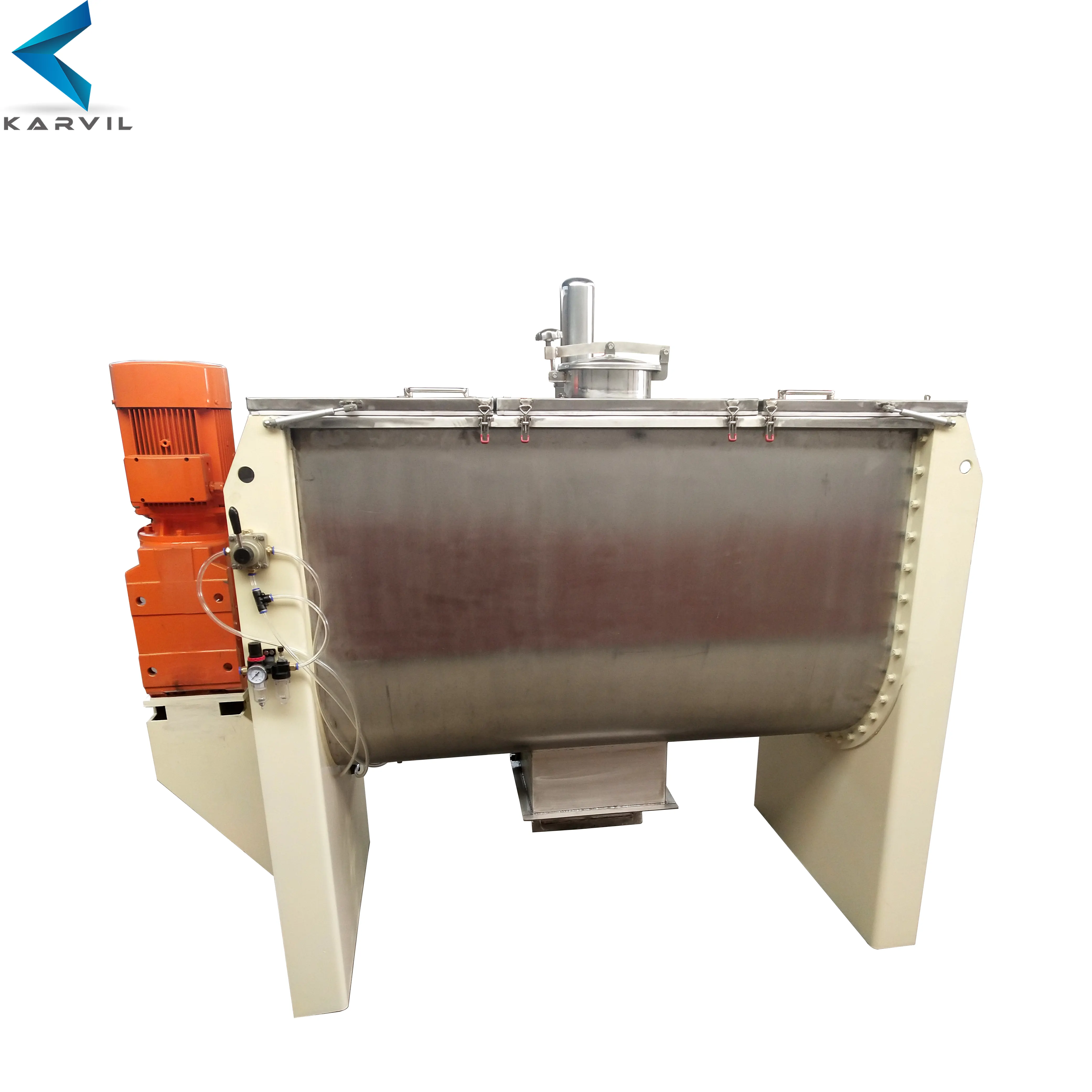
Karvil horizontal ribbon mixer gives you more choices!
HORIZONTAL RIBBON MIXER SELECTION WAY:
1. Choose the batch working capacity from 0.1cbm to 20cbm, select mixer accordingly.
2. Choose material for the part contact with raw material, non-contact with raw material, other parts like motor and reducer, bearing material can not be chosen; According to the material to be mixed, processing condition, health level, raw material canbe mild steel, sus304, sus316L, sus321; And choose the surface treatment according to the raw material.
3. Motor power is chosen according to the material gravity, fluidity, and operation.
Operation is divided as: Start mixer when it is empty (normal duty); Start mixer with load (heavy duty)
4. Adding the auxiliary components like spraying, heating and cooling according to processing condition.
5. Mixer inlets: feeding ports, cleaning port, vent.
6. Chose discharging and driven mode: manual, pneumatic and electric.
FLEXIBLE MATERIAL SELECTION:
The mixer can be customized with carbon steel, manganese steel, 304 stainless steel, 316L stainless steel, 321 stainless steel and other materials, and different materials can also be used in combination;
When selecting equipment materials, distinguish: parts in contact with materials and parts not in contact with materials; inside the mixer can also be targeted to add functional coatings or protective layers such as anti-corrosion, anti-adhesion, isolation, and wear resistance;
Stainless steel surface treatment can be divided into sandblasting, wire drawing, polishing, mirror and other treatment methods, and can be applied to different parts of use;
Discover the key advantages of ribbon blenders for powder mixing: uniform blending, versatility across industries, high efficiency, gentle action, and easy maintenance. Explore Karvil Machinery's durable solutions.
Discover if sigma blade mixers are ideal for wet granulation in pharmaceuticals and chemicals. Explore advantages, Karvil's Z blade mixers features, design benefits, and comparisons for efficient mixing.
If you are working with Polyester BMC (Bulk Moulding Compound) or DMC, you know the struggle. The material is heavy, incredibly sticky, and tricky to mix.The biggest headache? Glass fibres.You need strong shear force to mix the resin and filler paste, but if the blades run too fast or too hard once
We have successfully completed the fabrication and testing of 10 Sigma Blade Mixers tailored for a specialized application in Turkey involving Cotton and Alcohol/Solvents.Project Breakdown & Technical Focus:Processing cotton with solvents requires high shear force combined with rigorous safety stand
Discover the core construction of Sigma blade mixers: Z-shaped stainless steel blades, jacketed U-troughs for precise temperature control, and hydraulic discharge systems. Ideal for high-viscosity mixing in rocket fuel, explosives, and more. Explore innovations from Karvil for efficient, safe blending.
The Real Challenge with Silicone RubberIf you work with silicone rubber (HTV, RTV, or LSR), you know the headache: Viscosity.We aren't talking about mixing paint or oil. Raw silicone gum is tough. It has a viscosity that can easily exceed 1,000,000 centipoise (cps). It behaves more like a solid piec
Discover how sigma blade mixers resist corrosive chemicals. Learn about SS316L materials, PTFE seals, surface treatments & Karvil's corrosion-resistant designs.
Sigma mixers excel in protein bar production with Z-blade kneading for dense pastes, syrups, and add-ins. Karvil’s food-grade models ensure even texture, hygiene, and easy integration.