Views: 88 Author: Site Editor Publish Time: 2026-02-20 Origin: Site
The world of manufacturing is seeing a huge change right now, driven by the massive push for "New Energy." As the market for electric vehicles (EVs) and large systems for storing power grows faster than anyone expected, the need for lithium-ion batteries has shifted. It is no longer just about making a lot of batteries to keep up with orders. It has become a strict demand for high quality.
In this high-pressure world of factory production, getting the electrode slurry ready is arguably the most important "first step" of the whole process. The smoothness and evenness of this slurry are what directly decide if the battery will work well or if it will be thrown away. This is exactly why the Planetary Mixers have become more than just another machine. They are now the essential heart of the front end of the battery production line.
Making a battery is a long and complicated chain of events, but everything starts with mixing. You have to take active materials, things that help conduct electricity, and binders that hold it all together, and mix them up. In the past, simple mixing was okay because batteries did not need to hold that much power. However, today’s market is different. Everyone wants batteries that can hold more energy and charge up much faster.
This change has brought a very big problem to the factory floor: High Solid Content. Modern battery mixtures, or slurries, are becoming thicker and thicker. Manufacturers do this to pack in more energy and use less liquid solvent. Standard mixers often fail when they try to handle these materials that feel more like thick paste than liquid. Old machines often leave behind "dead zones" where the powder does not get wet or mixed in. This problem in the industry has made the advanced planetary mixer the top choice for making high-performance batteries.
There is a trend evident in the construction of factories today. Companies are no longer using simple mixing devices, but are looking for heavy-duty equipment. They need machines that will be able to run around the clock and are able to handle materials that are difficult to mix. This is exactly what the technology behind a planetary mix is able to accomplish. It is more than just rotating a blade, it is understanding the flow of materials and the way to effectively mix them.
To the naked eye, a batch of black battery slurry might look like it is all the same. However, if you look at it under a microscope, consistency is the difference between a top-tier battery and a safety hazard.
The evenness of the slurry affects three very important parts of the final product:
Coating Precision: If the slurry has clumps of unmixed powder (which engineers call agglomerates), the next step in the process will be messy. When the machine tries to spread this paste onto the metal foil, it will result in uneven thickness. Some spots will be too thick, and others too thin. This leads to a battery that does not have a stable capacity and cannot release power smoothly.
Electrochemical Performance: A slurry that is mixed well ensures that the conductive agent forms a complete web around the active material. If the dispersion is poor, this web breaks. This causes High Internal Resistance. When resistance is high, the battery has to work harder to push power out, which generates extra heat and lowers the total power output.
Safety Risks: This is the most serious factor. Slurry that is not uniform can create "hot spots" on the electrode. When you charge the battery, these spots get more current than they can handle. This can lead to lithium building up in sharp crystals. Over time, these sharp crystals can poke through the separator inside the battery. If that happens, you get a short circuit, and the battery could catch fire.
Therefore, making sure the mix is perfectly the same all the way through is not just about following rules; it is a matter of safety for the person using the car or device.
When we talk about consistency, we are also talking about money. If a batch of slurry is bad, you waste expensive materials. You lose time cleaning the machine. You lose the time it took to run the batch. In a busy factory, these losses add up very quickly. That is why getting the right mixer, one that guarantees consistency every single time, is so important for the business bottom line.


Why is the planetary mixer the only machine really suited for this hard job? The answer is in its name and the way it moves.
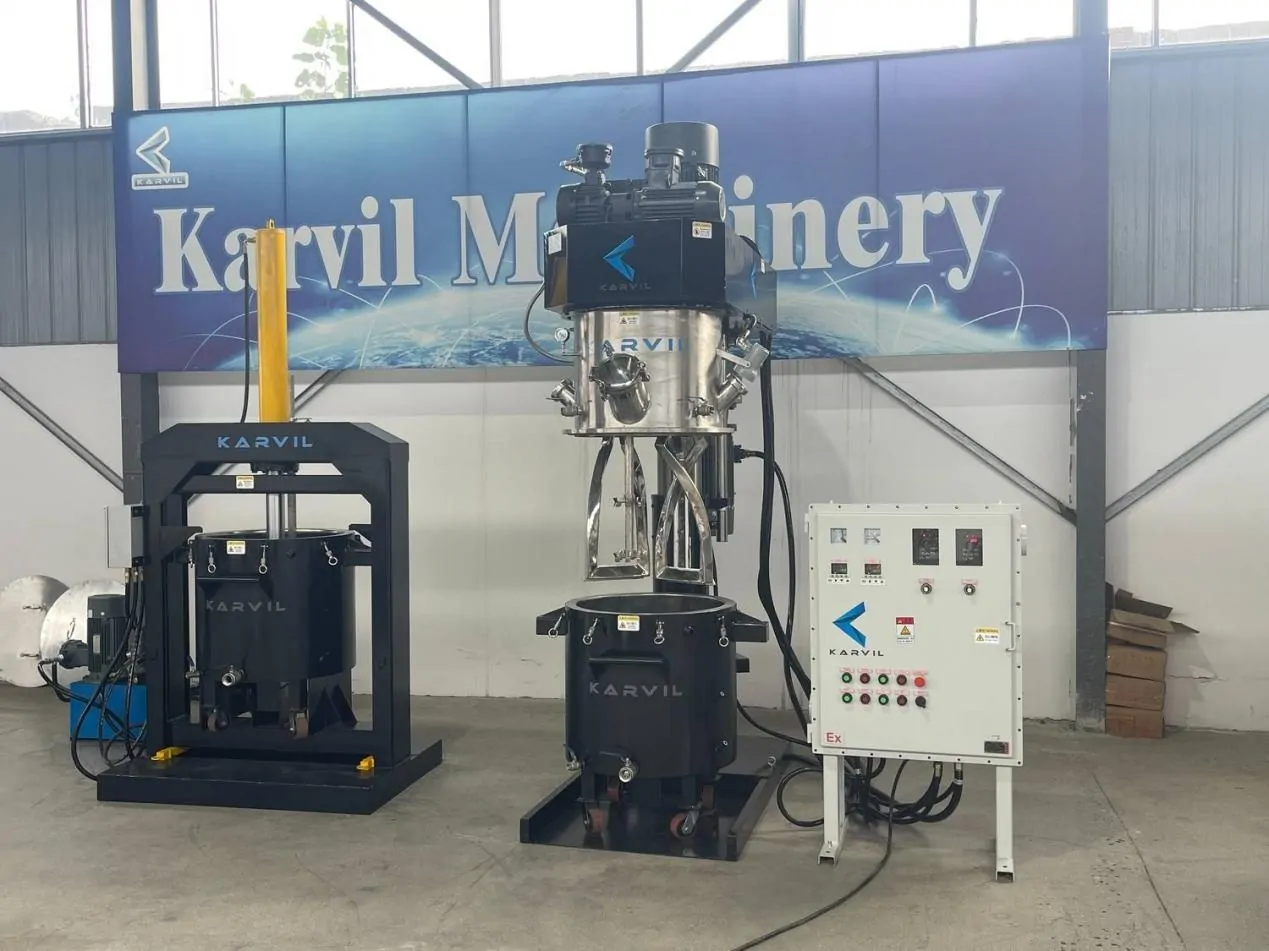
Unlike standard single-shaft mixers that just spin in one place, an Industrial Planetary Mixer uses a double-motion system that copies the movement of planets in space:
Revolution (Public Rotation): The whole mixing group rotates around the center of the tank, just like the Earth goes around the sun.
Rotation (Self-Spinning): The mixing blades spin on their own center points while they are moving around the tank, just like the Earth spinning on its axis.
This complex movement creates a powerful kneading effect. It is like kneading dough but with much more force. The low-speed paddles push the material up, down, and around. This makes sure that there is "macro-scale" mixing, meaning the stuff at the bottom gets moved to the top, and the stuff on the sides gets pulled into the middle. There are no dead zones near the tank walls where material can hide.
At the same time, high-speed dispersion discs are spinning very fast. They apply intense force to cut and break down tiny clumps of powder.
For materials that are very thick and sticky (often exceeding 100,000 cps in battery work), this combination of high power and smart movement is the only way to make sure the binder dissolves completely and the active materials are spread out evenly. If you used a normal mixer, the thick paste would just stick to the walls or spin around the blade without actually mixing. The planetary action forces the material to interact, breaking it down and folding it back together over and over again until it is perfect.
At Karvil, we understand that the idea of planetary mixing is great, but it must be built into a real machine that works. Our solutions are specifically changed and improved for the hard demands of the lithium-ion industry, fixing the specific problems that come with high-solid content slurries.
One of the biggest enemies of battery coating is the air bubble. In thick slurries, bubbles get trapped easily. They act like little blockers and mess up the surface when you try to coat it. Karvil’s mixers are built with very strong mechanical seals. These seals keep a vacuum level of ≤-0.098 MPa. This high-vacuum environment is kept during the whole mixing time. It effectively pulls trapped air out of the dense paste. The result is a tight, bubble-free mixture that ensures a smooth electrode coating without any holes or defects.
Think of it like trying to get air out of thick mud. If you just stir it, the air stays. If you suck the air out while you stir, the mud becomes solid and smooth. That is what our vacuum system does. It makes sure that when the slurry goes to the next machine, it is pure material, not material mixed with air.
Standard blades can sometimes just push material in a circle without really folding it over. Karvil uses advanced designs for our blades (such as twist or frame paddles) that are tested on computers first. These designs force the material to move up and down as well as side to side. In our Industrial Planetary Mixer series, the low-speed stirring part works together with the high-speed disperser (which can go up to 1500 rpm). This ensures that even the dry powders that are hardest to mix get wet by the solvent very quickly. This cuts down the total time you need to mix and lets the machine handle even more solid powder without getting stuck.
We look at the flow of the material like a fluid dynamic puzzle. By changing the angle and shape of the blade, we can make sure that every gallon of slurry passes through the high-speed mixer many times. This guarantees that there are no "unlucky" pockets of powder that escape the mixing process.
When you mix things with a lot of force, it creates heat. Friction makes things hot. If a battery slurry gets too hot during mixing, the chemical binder can break down. If the binder breaks, the batch is ruined. Karvil mixers feature tanks with jackets around them for precise cooling. You can pump cold water through the jacket to keep the slurry temperature exactly where it needs to be. Also, because cathode materials can be rough like sand, the parts of our machine that touch the mix are treated with special coatings. These coatings are very hard and stop the metal from wearing down. This prevents tiny pieces of metal from getting into the mix, which is a strict rule for making batteries for cars.
Control over temperature is vital because battery chemistry is sensitive. If you cook the slurry, you change how it reacts. Our cooling systems are designed to react fast, pulling heat away as soon as it is generated by the high-speed spinning. This keeps the chemical properties of the slurry safe and stable.
As the electric vehicle market races forward, the "heart" of the production line must be strong, reliable, and precise. The planetary mixer is no longer just a mixing tool; it is a precision instrument that dictates the DNA of the battery cell.
Investing in the best available mixing solutions, such as those offered by Karvil, is a forward-thinking investment in the safety and quality of your energy products. Whether you're running small-scale tests, ramping up to maximum production, or anywhere in between, slurry homogeneity is the clear path forward to staying ahead of the competition.
Make a wrong turn in terms of equipment, however, and you'll pay for it down the line in terms of failed batteries and safety recalls. But invest in a solution that understands the science of mixing, and you're laying a foundation that will support a battery that people can depend on. The battery business is a competitive one, and it's a safe bet that those who lead the pack will be those who produce the highest-quality slurry, again and again, over time.
A: The vacuum function is super important because battery slurry is usually very thick and sticky. If you do not have a vacuum, air bubbles will get stuck inside the mix while the machine is stirring. These bubbles are a big problem. They create tiny holes, called pinholes, when you try to spread the coating. These holes increase internal resistance and can even cause the battery to fail later on. A vacuum environment (like the ≤-0.098 MPa provided by Karvil mixers) pulls these bubbles out to make sure you have a dense and conductive electrode layer that works perfectly. It essentially sucks the air out so only the good material is left.
Q: Can the Karvil Industrial Planetary Mixer handle both anode and cathode slurries?
A: Yes, absolutely. The mixer is very flexible and works well with many different types of battery chemistry. This includes Lithium Iron Phosphate (LFP), Ternary Lithium (NCM), and graphite materials used for anodes. You can adjust the mixing speed and choose different blade designs to match the different weights and roughness of these materials. Whether the powder is light and fluffy or heavy and rough, the machine can be tuned to handle it. This versatility makes it a great choice for factories that might need to change what they are making as technology improves.
A: A Double Planetary Mixer has two agitators that revolve and rotate at the same time. This basically doubles the kneading power and cuts the mixing time in half compared to a single-shaft version. But more importantly, the way the two blades interact creates a zone of high shear. This is critical for breaking down stubborn clumps in slurries that have a lot of solid powder. It ensures a much higher degree of uniformity. A single shaft might just push the clump around, but dual shafts will trap the clump between them and break it apart. This leads to a much smoother and better quality mixture in the end.


